
Training on an Isokinetic Machine
Duration: 60′
Cost: €40
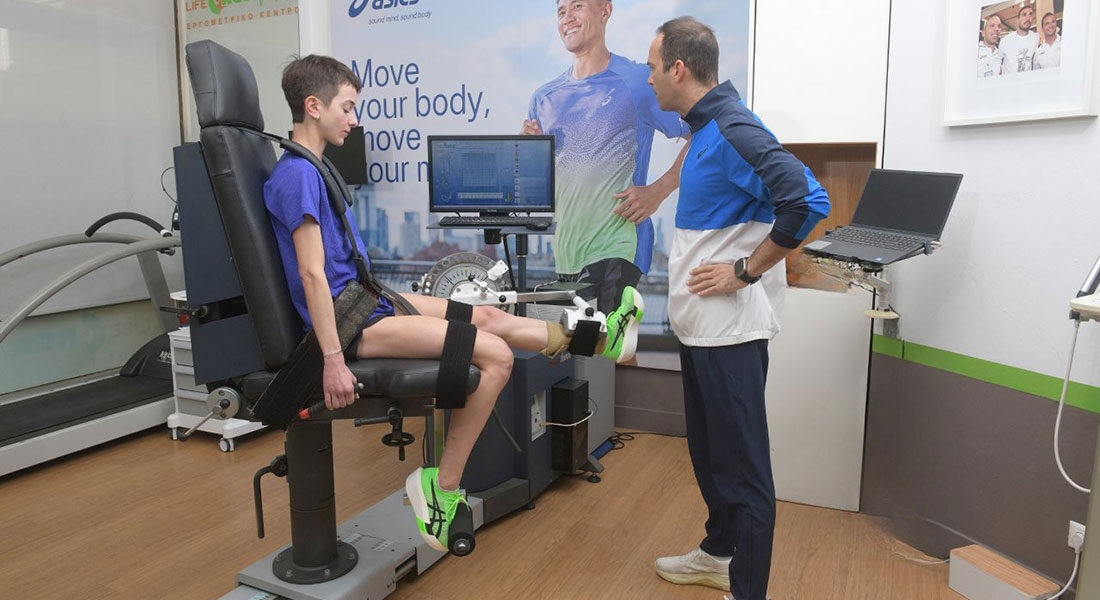
The isokinetic machine is a state-of-the-art tool for athletic assessment and rehabilitation, allowing movements to be performed at a constant speed, regardless of how much force the athlete applies.
How does it work?
Unlike traditional weights, where speed changes and resistance remains constant, the opposite happens with an isokinetic machine: you select the movement speed (for example, 60 or 180 degrees per second), and the machine adjusts the resistance so that you cannot exceed that speed, no matter how much force you apply.
Why is it so important?
- Objective measurement: It is the only tool that provides precision data on muscle strength at every degree of movement. It shows us exactly where weakness exists.
- Safety: The machine’s resistance is proportional to the force you apply. If you feel pain and stop, the machine immediately stops applying resistance.
- Identification of weaknesses: It allows us to see whether the strength ratio between the legs or between muscle groups (for example, quadriceps vs hamstrings) is correct.
When is it used?
- Injury prevention: To identify whether a muscle is weak and at risk of strain.
- After surgery: It is the “judge” that tells us with actual numbers whether an athlete can safely return to the field or court, for example after an ACL rupture.
- Performance improvement: For the development of maximum power and muscular endurance in a fully controlled way.
What are the benefits of training on an isokinetic machine?
- Maximum safety and control
The machine adjusts the resistance exactly to the force applied by the athlete. If you get tired or feel pain and stop pushing, the resistance drops instantly to zero, minimizing the possibility of injury.
- Detection of muscle imbalances
It is the only tool that can accurately measure deficits between the right and left leg or between agonist and antagonist muscles, for example quadriceps vs hamstrings. As we know, these deficits should remain below 15% for a safe return to athletic activity.
- Rehabilitation and return to play
It provides objective data on when an athlete is ready to return after surgery, such as ACL reconstruction. It helps restore maximum torque completely, ensuring that the operated limb has regained its strength.
- Training through the full range of motion
Unlike free weights, where resistance changes due to gravity, in isokinetic training muscle activation is maximal at every degree of movement. This leads to faster and higher-quality strengthening.
- Objective evaluation
The athlete receives a detailed report with graphs showing average peak torque and strength relative to body weight. For example, in knee extension we aim for values above 3.3 and in knee flexion above 2.2, so that the limb is considered sufficiently strong.