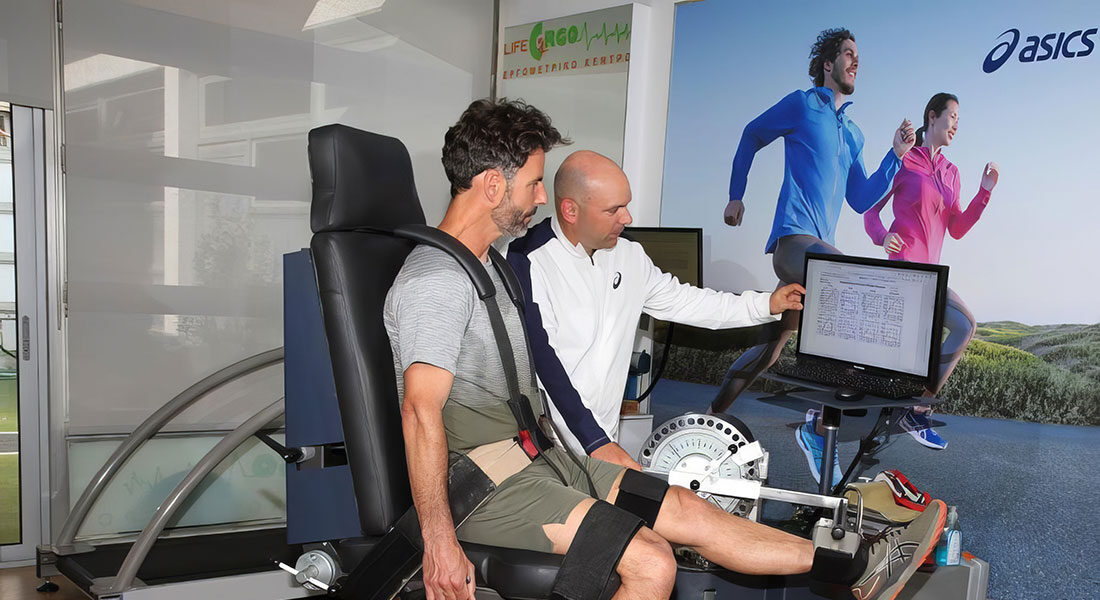
Our isokinetic evaluation, priced at €60, is an essential tool that allows us to accurately identify lower-limb muscle strength deficits. This service is suitable for both athletes and non-athletes who want to assess the functionality and strength of their legs.
Its use is particularly important in the post-surgical stage. For athletes who have undergone knee surgery, this assessment shows whether muscle strength has returned to normal levels and whether there is weakness in the quadriceps or hamstrings. Our goal is to confirm that the peak torque is at the optimal level and that deficits remain below 15%, reducing the risk of re-injury.
Upon completion of the assessment, the client receives a detailed report with the evaluation findings. In addition, specific training guidelines are provided based on the results, in order to correct asymmetries and achieve maximum balance and stability in the lower limbs.
Includes:
1. Health Screening – Anthropometric Assessment
Body fat %, Body fat kg, Fat-free mass, Muscle mass, Total body water, Extracellular fluid, Intracellular fluid, Body mass index, Bone mass, Body classification, Visceral fat, ECW/TBW ratio, Basal metabolic rate, Phase Angle, Basal Metabolic Rate indicator, Metabolic age, Body fat distribution, Muscle mass balance, Lower limb muscle performance, Segmental analysis for each lower and upper limb and trunk: Fat percentage and evaluation, Muscle mass in kg and evaluation, Reactance/resistance and phase angle, desirable normal ranges.
2. Isokinetic Evaluation of the Lower Limbs
Isokinetic testing with the help of isokinetic systems is a popular method of muscle assessment. Isokinetic exercise, performed at a joint within a defined range of motion and at a constant angular velocity throughout the entire range, is widely used in the evaluation of physical performance and injuries.
A pioneering innovation in the field of sports and rehabilitation from the Life Ergo Ergometric Center
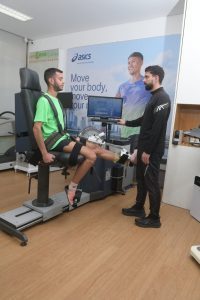 One of the leading isokinetic dynamometers from the world-renowned company Turh GmbH. Isoforce is the ultimate muscle performance assessment tool, providing information on muscle strength, endurance, and power through isokinetic testing, while also identifying muscular imbalances, dysfunctions, and weaknesses.
Isokinetic testing is the most reliable method for evaluating and treating muscle function and is performed during isokinetic exercise.
With the help of the Isoforce isokinetic dynamometer, isokinetic testing can be performed on any joint of the human body within a defined range of motion and at a constant angular velocity.
In this way, it is possible to assess muscle strength, the presence of imbalances or dysfunctions between opposing muscle groups, such as quadriceps and hamstrings, as well as between bilateral muscle groups. These results are generated immediately through the Turh GmbH operating system after the isokinetic evaluation.
The use of the isokinetic machine is not limited only to pre-operative and post-operative applications. Benefits have also been observed in the prevention of musculoskeletal injuries across all muscle groups of the body, depending on the needs of each individual.
Identification of muscle group dysfunctions
Isokinetic evaluation offers the ability to identify dysfunctions and imbalances both between opposing muscle groups and between bilateral muscle groups through the analysis of the strength ratios produced during isokinetic testing.
Our isokinetic evaluation, priced at €60, is an essential tool that allows us to accurately identify lower-limb muscle strength deficits. This service is suitable for both athletes and non-athletes who want to assess the functionality and strength of their legs.
Its use is particularly important in the post-surgical stage. For athletes who have undergone knee surgery, this assessment shows whether muscle strength has returned to normal levels and whether there is weakness in the quadriceps or hamstrings. Our goal is to confirm that the peak torque is at the optimal level and that deficits remain below 15%, reducing the risk of re-injury.
Upon completion of the assessment, the client receives a detailed report with the evaluation findings. In addition, specific training guidelines are provided based on the results, in order to correct asymmetries and achieve maximum balance and stability in the lower limbs.
Includes:
1. Health Screening – Anthropometric Assessment
Body fat %, Body fat kg, Fat-free mass, Muscle mass, Total body water, Extracellular fluid, Intracellular fluid, Body mass index, Bone mass, Body classification, Visceral fat, ECW/TBW ratio, Basal metabolic rate, Phase Angle, Basal Metabolic Rate indicator, Metabolic age, Body fat distribution, Muscle mass balance, Lower limb muscle performance, Segmental analysis for each lower and upper limb and trunk: Fat percentage and evaluation, Muscle mass in kg and evaluation, Reactance/resistance and phase angle, desirable normal ranges.
2. Isokinetic Evaluation of the Lower Limbs
Isokinetic testing with the help of isokinetic systems is a popular method of muscle assessment. Isokinetic exercise, performed at a joint within a defined range of motion and at a constant angular velocity throughout the entire range, is widely used in the evaluation of physical performance and injuries.
A pioneering innovation in the field of sports and rehabilitation from the Life Ergo Ergometric Center
One of the leading isokinetic dynamometers from the world-renowned company Turh GmbH. Isoforce is the ultimate muscle performance assessment tool, providing information on muscle strength, endurance, and power through isokinetic testing, while also identifying muscular imbalances, dysfunctions, and weaknesses.
Isokinetic testing is the most reliable method for evaluating and treating muscle function and is performed during isokinetic exercise.
With the help of the Isoforce isokinetic dynamometer, isokinetic testing can be performed on any joint of the human body within a defined range of motion and at a constant angular velocity.
In this way, it is possible to assess muscle strength, the presence of imbalances or dysfunctions between opposing muscle groups, such as quadriceps and hamstrings, as well as between bilateral muscle groups. These results are generated immediately through the Turh GmbH operating system after the isokinetic evaluation.
The use of the isokinetic machine is not limited only to pre-operative and post-operative applications. Benefits have also been observed in the prevention of musculoskeletal injuries across all muscle groups of the body, depending on the needs of each individual.
Identification of muscle group dysfunctions
Isokinetic evaluation offers the ability to identify dysfunctions and imbalances both between opposing muscle groups and between bilateral muscle groups through the analysis of the strength ratios produced during isokinetic testing.
Our isokinetic evaluation, priced at €60, is an essential tool that allows us to accurately identify lower-limb muscle strength deficits. This service is suitable for both athletes and non-athletes who want to assess the functionality and strength of their legs.
Its use is particularly important in the post-surgical stage. For athletes who have undergone knee surgery, this assessment shows whether muscle strength has returned to normal levels and whether there is weakness in the quadriceps or hamstrings. Our goal is to confirm that the peak torque is at the optimal level and that deficits remain below 15%, reducing the risk of re-injury.
Upon completion of the assessment, the client receives a detailed report with the evaluation findings. In addition, specific training guidelines are provided based on the results, in order to correct asymmetries and achieve maximum balance and stability in the lower limbs.
Includes:
1. Health Screening – Anthropometric Assessment
Body fat %, Body fat kg, Fat-free mass, Muscle mass, Total body water, Extracellular fluid, Intracellular fluid, Body mass index, Bone mass, Body classification, Visceral fat, ECW/TBW ratio, Basal metabolic rate, Phase Angle, Basal Metabolic Rate indicator, Metabolic age, Body fat distribution, Muscle mass balance, Lower limb muscle performance, Segmental analysis for each lower and upper limb and trunk: Fat percentage and evaluation, Muscle mass in kg and evaluation, Reactance/resistance and phase angle, desirable normal ranges.
2. Isokinetic Evaluation of the Lower Limbs
Isokinetic testing with the help of isokinetic systems is a popular method of muscle assessment. Isokinetic exercise, performed at a joint within a defined range of motion and at a constant angular velocity throughout the entire range, is widely used in the evaluation of physical performance and injuries.
A pioneering innovation in the field of sports and rehabilitation from the Life Ergo Ergometric Center
One of the leading isokinetic dynamometers from the world-renowned company Turh GmbH. Isoforce is the ultimate muscle performance assessment tool, providing information on muscle strength, endurance, and power through isokinetic testing, while also identifying muscular imbalances, dysfunctions, and weaknesses.
Isokinetic testing is the most reliable method for evaluating and treating muscle function and is performed during isokinetic exercise.
With the help of the Isoforce isokinetic dynamometer, isokinetic testing can be performed on any joint of the human body within a defined range of motion and at a constant angular velocity.
In this way, it is possible to assess muscle strength, the presence of imbalances or dysfunctions between opposing muscle groups, such as quadriceps and hamstrings, as well as between bilateral muscle groups. These results are generated immediately through the Turh GmbH operating system after the isokinetic evaluation.
The use of the isokinetic machine is not limited only to pre-operative and post-operative applications. Benefits have also been observed in the prevention of musculoskeletal injuries across all muscle groups of the body, depending on the needs of each individual.
Identification of muscle group dysfunctions
Isokinetic evaluation offers the ability to identify dysfunctions and imbalances both between opposing muscle groups and between bilateral muscle groups through the analysis of the strength ratios produced during isokinetic testing.
Our Ergometric Center uses Isokinetic Evaluation for:
- Ergometric measurements
- Post-surgical rehabilitation
- Pre-surgical strengthening
- Injury rehabilitation
Isokinetic exercise is primarily characterized by constant speed and a consistent movement path throughout the entire exercise. In this way, the muscles are not overloaded and the muscles being strengthened work through the full range of motion.
Isokinetic Evaluation uses the measurements of the Isokinetic Dynamometer and provides the following information:
- Muscle imbalances
- Maximum power of the tested muscle groups
- Contraction speed
- Neuromuscular coordination
- Comparative evaluation
- Muscle strengthening
- Muscle coordination
- Muscular endurance
- Speed-strength
- Active joint mobilization
- Monitoring rehabilitation progress
- Prevention
- Research
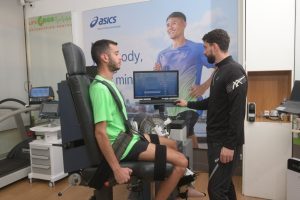 Isokinetic exercise is primarily characterized by constant speed and a consistent movement path throughout the entire exercise. In this way, the muscles are not overloaded and the muscles being strengthened work through the full range of motion.
This is also the advantage of isokinetic exercise over isotonic weight training, where resistance is constant but speed varies. As a result, the load at one point in the movement may be insufficient, while at another point it may be excessive and harmful to the joint. Therefore, by having a controlled exercise environment and a proper strengthening program, muscular strengthening of the patient is achieved in a shorter period of time, with complete safety.
Isokinetic dynamometry is the most reliable and accurate way to measure muscle performance, since there is no uncontrolled external interference, and the person being tested is safe in the knowledge that in case of pain or injury, the movement stops immediately.
The Isokinetic Dynamometer is a high-technology machine that measures various parameters of muscle performance in the joints of the knee, shoulder, wrist, elbow, and ankle.
It provides controlled and constant movement speed and, together with the precise programming of the limb’s movement path and consequently muscle length, ensures control of the main factors affecting muscle performance, namely movement speed and muscle length.
Our Ergometric Center uses Isokinetic Evaluation for:
- Ergometric measurements
- Post-surgical rehabilitation
- Pre-surgical strengthening
- Injury rehabilitation
Isokinetic exercise is primarily characterized by constant speed and a consistent movement path throughout the entire exercise. In this way, the muscles are not overloaded and the muscles being strengthened work through the full range of motion.
Isokinetic Evaluation uses the measurements of the Isokinetic Dynamometer and provides the following information:
- Muscle imbalances
- Maximum power of the tested muscle groups
- Contraction speed
- Neuromuscular coordination
- Comparative evaluation
- Muscle strengthening
- Muscle coordination
- Muscular endurance
- Speed-strength
- Active joint mobilization
- Monitoring rehabilitation progress
- Prevention
- Research
Isokinetic exercise is primarily characterized by constant speed and a consistent movement path throughout the entire exercise. In this way, the muscles are not overloaded and the muscles being strengthened work through the full range of motion.
This is also the advantage of isokinetic exercise over isotonic weight training, where resistance is constant but speed varies. As a result, the load at one point in the movement may be insufficient, while at another point it may be excessive and harmful to the joint. Therefore, by having a controlled exercise environment and a proper strengthening program, muscular strengthening of the patient is achieved in a shorter period of time, with complete safety.
Isokinetic dynamometry is the most reliable and accurate way to measure muscle performance, since there is no uncontrolled external interference, and the person being tested is safe in the knowledge that in case of pain or injury, the movement stops immediately.
The Isokinetic Dynamometer is a high-technology machine that measures various parameters of muscle performance in the joints of the knee, shoulder, wrist, elbow, and ankle.
It provides controlled and constant movement speed and, together with the precise programming of the limb’s movement path and consequently muscle length, ensures control of the main factors affecting muscle performance, namely movement speed and muscle length.
Our Ergometric Center uses Isokinetic Evaluation for:
- Ergometric measurements
- Post-surgical rehabilitation
- Pre-surgical strengthening
- Injury rehabilitation
Isokinetic exercise is primarily characterized by constant speed and a consistent movement path throughout the entire exercise. In this way, the muscles are not overloaded and the muscles being strengthened work through the full range of motion.
Isokinetic Evaluation uses the measurements of the Isokinetic Dynamometer and provides the following information:
- Muscle imbalances
- Maximum power of the tested muscle groups
- Contraction speed
- Neuromuscular coordination
- Comparative evaluation
- Muscle strengthening
- Muscle coordination
- Muscular endurance
- Speed-strength
- Active joint mobilization
- Monitoring rehabilitation progress
- Prevention
- Research
Isokinetic exercise is primarily characterized by constant speed and a consistent movement path throughout the entire exercise. In this way, the muscles are not overloaded and the muscles being strengthened work through the full range of motion.
This is also the advantage of isokinetic exercise over isotonic weight training, where resistance is constant but speed varies. As a result, the load at one point in the movement may be insufficient, while at another point it may be excessive and harmful to the joint. Therefore, by having a controlled exercise environment and a proper strengthening program, muscular strengthening of the patient is achieved in a shorter period of time, with complete safety.
Isokinetic dynamometry is the most reliable and accurate way to measure muscle performance, since there is no uncontrolled external interference, and the person being tested is safe in the knowledge that in case of pain or injury, the movement stops immediately.
The Isokinetic Dynamometer is a high-technology machine that measures various parameters of muscle performance in the joints of the knee, shoulder, wrist, elbow, and ankle.
It provides controlled and constant movement speed and, together with the precise programming of the limb’s movement path and consequently muscle length, ensures control of the main factors affecting muscle performance, namely movement speed and muscle length.