
Resting Metabolic Rate Measurement
Duration: 60′
Cost: €75
The Resting Metabolic Rate (RMR) test, priced at €75, is the ideal solution for anyone who wants to evaluate their metabolism and organize their nutrition with absolute accuracy. This service is not only for athletes, but is intended for anyone who wants to know the calories their body burns while at rest.
Measuring RMR provides the scientific basis for understanding your real energy needs. Our nutritionist then designs the appropriate nutrition plan, fully based on the individual needs and goals of the person being assessed.
Whether your goal is weight loss or the improvement of your health and well-being, this package gives you the essential tools you need. By combining accurate measurement with professional guidance, you can put your nutrition in order, ensuring that your body receives exactly what it needs to function efficiently and healthily.
Includes:
1. Health Screening – Anthropometric Assessment
Body fat %, Body fat kg, Fat-free mass, Muscle mass, Total body water, Extracellular fluid, Intracellular fluid, Body mass index, Bone mass, Body classification, Visceral fat, ECW/TBW ratio, Basal metabolic rate, Phase Angle, Basal Metabolic Rate indicator, Metabolic age, Body fat distribution, Muscle mass balance, Lower limb muscle performance, Segmental analysis for each lower and upper limb and trunk: Fat percentage and evaluation, Muscle mass in kg and evaluation, Reactance/resistance and phase angle, desirable normal ranges.
2. Resting Metabolic Rate Measurement (RMR)
Resting metabolic rate, energy balance, specialized nutrition program. With this specific measurement, we accurately determine daily energy expenditure in order to create a proper nutrition plan or support weight loss.
3. Personalized Nutrition Plan
Along with the results, a personal file is provided to the athlete with their nutrition plan, after consultation with the nutritionist “Eirini Babaroutsi, Ph.D.”
Metabolism measurement is an important assessment for people who want to know their daily energy expenditure with accuracy, with the goal of developing a proper nutrition plan or losing weight.
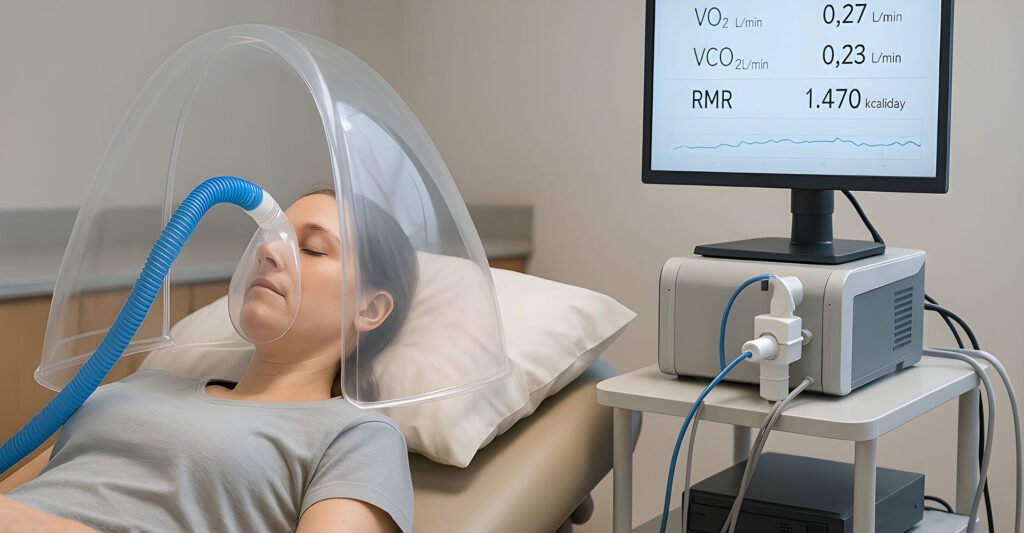
Using the most modern and advanced resting metabolic rate measurement device, oxygen consumption is measured accurately and the individual’s energy requirements are determined. Guided by the reliability of the results and knowing the exact resting metabolic rate, we create specialized nutrition programs tailored to the needs of each person, whether active or not, regardless of level and age.
What is RMR?
Resting Metabolic Rate (RMR) represents the calories our body consumes in order to carry out its vital functions, such as heart rate, brain function, and breathing. More simply, it is the number of calories a person burns daily while awake but at rest. RMR can represent up to 75% of the energy needs of the modern individual.
How do we measure RMR?
Resting Metabolic Rate is traditionally determined through direct or indirect calorimetry. Direct calorimetry requires the accurate measurement of the total heat produced by the body, using large, expensive, and technologically complex machines. Indirect calorimetry determines metabolic rate from the oxygen consumed by the body. Traditionally, oxygen consumption measurements were carried out using large stationary devices (metabolic carts) of high cost, which require periodic maintenance, calibration, and specialized personnel to operate. In recent years, however, portable or desktop devices have appeared at lower cost, based on advanced technology, which accurately measure oxygen consumption and determine the energy requirements of the individual. Measuring oxygen consumption, instead of using general population equations, allows health and exercise scientists to make accurate decisions for their clients. With a simple breathing test lasting 10–15 minutes, we measure metabolism in order to determine a personalized caloric balance.
The uniqueness of RMR
Resting Metabolic Rate (RMR) is influenced by a number of factors, such as body mass, body composition (fat mass vs muscle mass), age, sex, and hormones. Muscle tissue burns more calories than fat tissue. Therefore, a person with more muscle tissue will have a higher RMR. A weight management study provides the following example: two women of the same age, weight, and height, both weighing 72 kg. The first has a body fat percentage of 33% and an RMR measurement of 1571 calories. The second woman has a body fat percentage of 48% and a resting metabolic rate of 1252 calories per day. Although both women have the same weight, height, and age, they have different resting metabolic rates due to their different body composition. Resting metabolic rate naturally decreases in adults at a rate of 2% per decade, but this decrease is mainly due to loss of muscle tissue. Men naturally have a higher metabolism than women, mainly because they tend to have higher percentages of muscle tissue. Certain hormones can also increase or decrease metabolism. In addition, the body’s response to stress or injuries affects RMR, making oxygen measurement necessary instead of relying on equations. Equations do not take into account individual variations, medical history, or the many other factors that affect resting metabolic rate.
Weight Loss
When a person loses weight, their metabolism may decrease. This should not be considered alarming, because the reduction in metabolism is the result of tissue loss, both fat and muscle. Ideally, weight loss involves a proportionally greater loss of fat tissue and some percentage of muscle tissue. Strength training programs during a weight loss plan may reduce muscle loss, but for most people some muscle loss is inevitable. During a weight loss program, the body may lower metabolism in response to reduced calorie intake. Most people experience this without realizing it. Weight loss may be easy for the first few kilos, but later it becomes more difficult, and concerning plateaus are very likely to appear. Once metabolism drops, food intake must be adjusted or activity must increase in order to continue losing the extra weight. The good news is that once the weight loss program is completed, metabolism may increase slightly when body weight stabilizes. During a weight loss program, it is useful to monitor changes in metabolism and make the necessary adjustments in food intake to achieve successful weight management.
Equation deviations
When managing a client’s or patient’s nutritional requirements, knowing their RMR is essential. Traditionally, health professionals who did not have access to measurement systems relied on RMR estimates through equations. Because metabolism differs from one person to another, these estimates very often lead to errors and inaccurate caloric balances. As a result, clients may be overfed or underfed, fail to reach their goals, and become discouraged. Research has shown that the use of equations can lead to deviations of up to 40%. As technology evolves, professionals must reconsider the practices they apply.
RMR from body fat analysis?
Many health professionals rely on the Basal Metabolic Rate reading shown by body composition analyzers, believing that it is an actual measurement. This is incorrect. Body composition analyzers use equations in which they apply the anthropometric data entered by the operator during the body fat assessment. Therefore, these readings also contain large margins of error that may reach up to 40%.
The most reliable method for determining caloric requirements is through measurement of Resting Metabolic Rate based on oxygen consumption during breathing. For this measurement, the use of an indirect calorimetry device is essential. Fitmate is a valuable tool in the hands of the health professional, who can now provide fully specialized nutrition programs based on each person’s actual energy needs.
Using the most modern and advanced resting metabolic rate measurement device, oxygen consumption is measured accurately and the individual’s energy requirements are determined. Guided by the reliability of the results and knowing the exact resting metabolic rate, we create specialized nutrition programs tailored to the needs of each person, whether active or not, regardless of level and age.